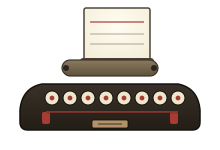
- Platen · roller
- The rubber cylinder that carries the paper forward and backs each keystroke.
- Type bar · —
- The metal arm with a slug of type that swings up to strike the paper when a key is pressed.
- Type ball / golf ball · element
- IBM Selectric's spherical printing element that tilts and rotates to print; the whole font swaps in one piece.
- Carriage · —
- The moving assembly carrying the platen; it advances with each keystroke and snaps back at line end.
- Carriage return · return
- Pushing the carriage back to the line start, advancing the paper — ancestor of the Enter key.
- Pica · 10 CPI
- A type size of 10 characters per inch — larger and readable, common in letters and official documents.
- Elite · 12 CPI
- A type size of 12 characters per inch — smaller, packing more text per page.
- CPI · chars per inch
- Characters Per Inch, the density measure. Pica = 10, Elite = 12.
- Ribbon · —
- The inked fabric (or film) band the type strikes to transfer ink. The classic is a red-and-black two-color ribbon.
- Bell / margin bell · end-of-line bell
- The end-of-line warning: it rings about 5–8 characters before the margin to cue the typist.
- QWERTY · keyboard layout
- The layout named after its top-left six letters, designed in the 1870s to reduce type-bar jams and still standard today.
- Shift key / Shift lock · —
- Lowers (or raises) the whole type-basket to print capitals/symbols; Shift Lock holds it.
- Segment · basket guide
- The curved metal guide all type bars pass through, keeping every bar on the same striking point.
- Escapement · —
- The mechanism that advances the carriage one uniform step per character — the heartbeat of typing rhythm.
- Margin stops · margins
- Movable stops on the carriage rail that set the typing width and trip the end-of-line bell.
- Tabulator · tab
- Jumps the carriage to the next preset stop for tables and indents — the ancestor of the Tab key.
- Touch · key action
- The overall feel of key travel and return; adjustable on many machines and a favourite collector criterion.
- Two-color ribbon selector · —
- A small lever switching the ribbon between red, black and blank (stencil) positions, usually at the keyboard's right.
- Platen knob · —
- The wheel at either end of the platen for manual paper feed and fine line adjustment.
- Backspace · —
- Steps the carriage back one space, for overstrikes and corrections.
- Keycap · key
- The round or square top of a key bearing its character; glass keys are especially prized on old machines.
- Type basket · —
- The assembly holding all type bars; it shifts as a unit for upper/lower case.
- Visible typewriter · —
- A machine whose type strikes in front of the paper so the typist sees the result — pioneered by Underwood.
- Blind writer · —
- Early machines with the paper hidden behind the platen — the typist can't see the text.
- Serial number · —
- The number on the machine's badge used to date production; each brand has its own serial system.
- Electric typewriter · —
- Motor-driven machines with lighter keys and even print, common from the 1950s.
Terms clear now? Walk the timeline or try the spec converter.