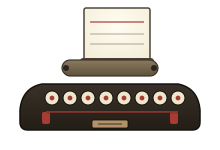
In 1961 IBM released the Selectric: no moving carriage, no type bars — just a ping-pong-sized metal ball spinning across the paper. Press a key and the ball tilts and rotates, printing the right character. It was so successful that by the 1970s, 75% of American offices used one. It was the summit of the typewriter — and its swan song.
History
The Selectric's heart was the typeball (golf-ball) mechanism, developed over more than a decade by IBM engineers, with industrial design by the legendary Eliot Noyes. The Selectric I hit the market in 1961 and took the world by storm; the typesetting-capable Composer followed in 1964, and the Selectric II of 1966 added correction.
In the 1980s the PC and word processors killed it. IBM sold its typewriter business to Lexmark in 1991. Today the Selectric — with its iconic ball, its distinctive typing sound and the clunk of the correction key — is beloved by video creators and collectors alike.
What makes it special
- Typeball revolution — The swappable ball offers dozens of typefaces (Courier, Prestige, Script…).
- No more jams — No type bars means no more clashing keys.
- Iconic sound — The Selectric's typing sound was the white noise of 20th-century offices — now an ASMR staple.
Classic models
| Model | Year | Notes |
|---|---|---|
| IBM Selectric I | 1961 | The original |
| IBM Selectric Composer | 1964 | Typesetting professional version |
| IBM Selectric II | 1966 | Added the correction key |
| IBM Selectric III | 1980 | Final generation |
Serial number dating (estimate)
Serial numbers give a rough production era. Precise dating needs the brand's official serial handbook.
| Period | Meaning |
|---|---|
| 1961 – 1965 | Selectric I |
| 1966 – 1979 | Selectric II era |
| 1980 – 1986 | Selectric III to end |
Try it out
Want to try typing on a vintage machine or estimate a serial number? Both are free, in your browser.
More brands: Olivetti, Remington, Royal, Smith-Corona, Hermès, Olympia, IBM Selectric.